By Julius Hendricks
When people imagine the perfect Mediterranean getaway, most think of the obvious options: a weekend on the French Riviera, driving down the Amalfi Coast, island hopping along the Adriatic Sea, or swimming in the Aegean. But what most travelers seem to overlook sits just south of Turkey and west of the Levant. “The Island Love”, Cyprus, is a gem that hosts all the beauty and history of the Mediterranean, packed into one divided island.
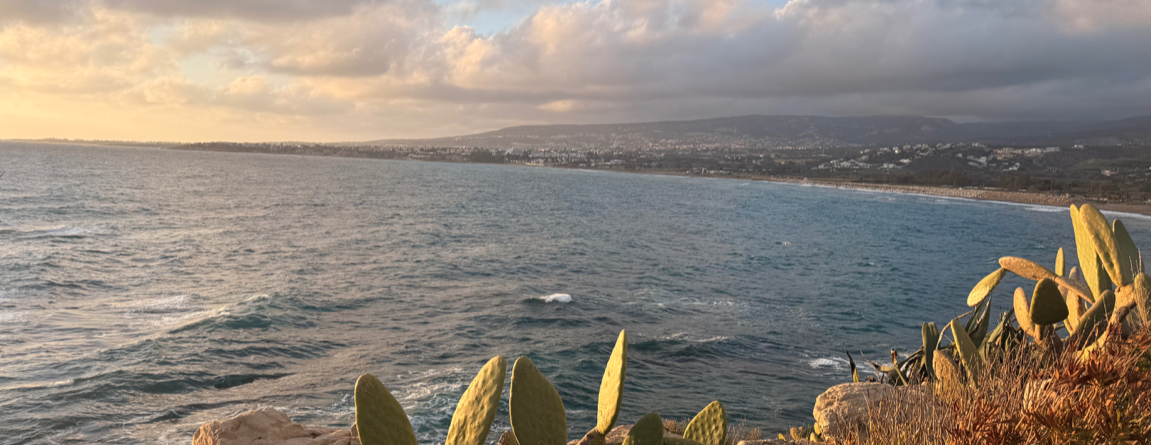
I had the pleasure of spending three incredible days on its western coast between Paphos and Pegeia, in a little beach town called Kissonerga. Cyprus, where the winds blew strongly, waves caressed saw-toothed beaches, and every village had a piece of history or an anecdote to go with it, which my tour guide proudly announced at every stop we made throughout the island.
Here’s a condensed history of Cyprus (before we get into the good stuff). In antiquity, the late Bronze Age brought waves of settlement by the Mycenaeans, attracted to the island’s mineral wealth in copper and its essential location at the crossroads of three continents. Over the next couple of thousand years, Cyprus was conquered by a multiplicity of empires. The Assyrians, Egyptians, Persians, and Macedonians all took power one after the other. Then came the Ptolemaic Empire, followed by the Classical and Eastern Roman Empire, Arab caliphates, the French Lusignans, Venetians, and the Ottomans, who held the island for three centuries, and finally the British, who held the island until its independence in 1960.
Today, Cyprus is split between two contesting communities in a conflict sparked after independence. A two-state solution of sorts has been reached, with “Greek Cyprus” inhabiting the southern half of the island, and the Turkish Republic in the north. The two sections are divided by the United Nations Buffer Zone, which is kilometers wide in some sections and only divided by a wall in its capital, Nicosia (or Lefkoşa). Seemingly untroubled by their history of violence, conflict, and occupation, the kindness and welcoming spirit of the Cypriot people could be felt in every village I had the privilege of visiting.
We spent the first day settling in, ready for the excitement the trip would bring. The second day consisted of walking 5km to the nearest fruit stand, where we bought a cornucopia of fruits grown on the island. The agriculture industry of Cyprus was once the backbone of its economy, but as more tourists began flooding the island year after year, the service industry became dominant. Agriculture continues to be a stable and profitable industry, where over 40 different fruits are grown year-round (thanks to its subtropical Mediterranean climate). My favorite was a small yellow-orange fruit called Loquot (in Cyprus it’s called Mespila), which is a stone fruit native to southern China and tastes like a mix of an apricot and a pear – absolutely delicious. We also checked out a couple of restaurants in the area, eating delicious hummus and seafood fresh from the sea.
On our last day, we booked a bus tour of the Greek side of Cyprus (as most tour companies only operate on one side or the other). My family was the first to be picked up, and as we made our way to pick up the rest of the eager passengers from their respective hotels in Paphos, we passed colorful orchards of orange trees, banana farms, and potato fields. Once the bus was full of conversations in a medley of languages, our guide, a Finnish woman named Ula, began the tour.
Our first stop was at the Rock of Aphrodite. According to Greek mythology, Aphrodite was born from the sea foam after the Titan Cronus severed his father, Uranus’s, genitals and threw them into the sea. The rock, which is more of a boulder, upon which she supposedly appeared, sits behind a much larger rock, which, according to legend, was thrown into the sea by the Byzantine hero Digenis Akritas to stop Saracen invaders, creating the formations seen today.
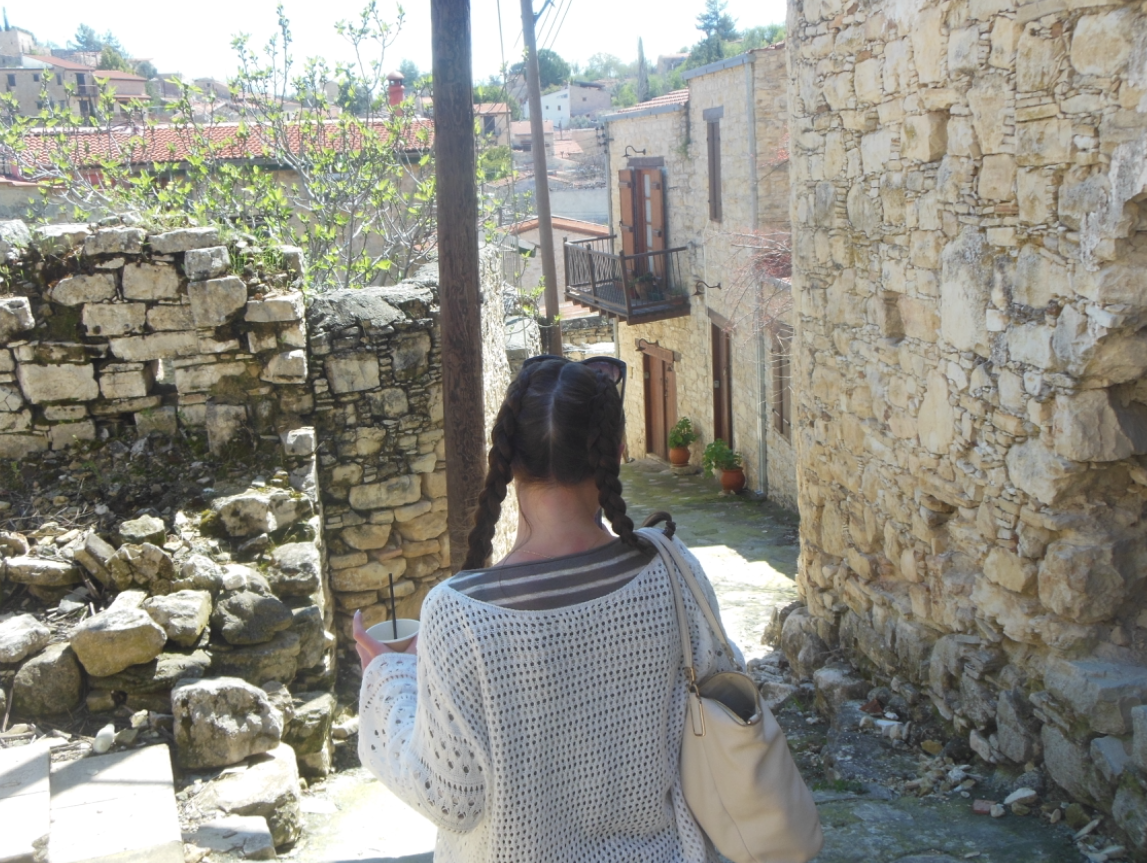
Next, we drove through the mountains to the small village of Lofou. Since we came during the weekend of Greek Orthodox Easter, most restaurants and stores were closed, and the streets were relatively empty besides the stray cats (they were everywhere). Lofou sits on the side of a mountain and has a beautiful church built in 1852, adorned with ancient paintings and frescoes. The village was surrounded by barren hills, which Ula said were because the Limassol wildfires had devastated the olive groves that once covered the terraced mountains. Nevertheless, the village was beautiful, and the locals in the few open shops and bakeries were welcoming and friendly.
After a brief stop at the famous Millomeris waterfall at the foot of Mount Olimbos (the tallest mountain in Cyprus), the tour continued to a winery up in the mountains where the wine tasting began. The two lions flanking the entrance welcomed our group as we entered the building. One lion’s face was frozen in anger, and the other was peacefully asleep. Ula motioned to the angry lion and said, “This is you when you enter,” then pointed at the other, “and this is you when you leave” (hinting that the wine is so good it’ll put us into a tranquil slumber).
The wine was accompanied by fresh bread with olive oil made from the nearby olive groves. The grand finale was an exclusively Cypriot wine called Commanderia. The rich, amber-colored, sweet dessert wine can only be produced in the Commanderia region of Cyprus, where it has been in production since its first documentation in 800 BC. The wine had a rich bourbon smell and tasted like a sweet, spiced syrup. After two more glasses, I had a wonderful nap on the ride down the mountain back to Kissonerga.
Cyprus is only a three-hour flight from Budapest, and if you’re looking for the perfect summer getaway, I wholeheartedly recommend visiting. It’s an island full of history, beautiful mountains and rocky cliffs, and incredible people.
Photos by Julius Hendricks