

By Daniel Kiss
In the heart of the Hungarian capital, an American professor by the name of Dr. Christopher Cox was interviewed by a once baffled student, amused by his striking convictions, stark against the normative positions of society. Identifying as both a Buddhist and a Marxist, a seemingly contradictory make-up worth investigating.
These two frameworks, one spiritual and contemplative, the other political and economic, offer distinct perspectives on life, ethics, and society. In conversation, Cox reveals how these seemingly divergent philosophies coexist within him, shaping his outlook on life. What began as a baffled curiosity on my part soon unfolded into an exploration of how one individual navigates such beliefs, balancing contemplation with critique, detachment with resolve, and how these perspectives ripple through every facet of his existence.
That balance extends beyond philosophy into his personal passions. Music, that passion which was once eclipsed for decades by activism and academic life, is now returning to the foreground. In recent years, having begun easing himself back into the artistic world he once lived inside so completely, his station at McDaniel has been a liberating retreat. “I’m not caught up in all the craziness of academic life… trying to get research grants, playing that whole game, trying to publish in journals, which I’ve done before and hated.” Going on to express how “This job allows me to have a little bit of flexibility so I can go on these little tours—five-day, ten-day tours here and there—and it allows me to establish myself as a musician. It’s been great.”

Thus, a man found in constant transition and reevaluation, a reliably mobile existence upon a spectrum in temperament and thought, passion and focus found in his person. Always seemingly capable of dismantling and restructuring a set of components in character that revitalize the life endured, his own subscription to Marxism and Buddhism being merely fractions of a greater whole being discussed. The critics that would cry out ‘contradiction’, pointing to how Buddhism’s detached, stoic-like approach to struggle will necessarily clash with Marxism’s striking resolve to attack and recreate, miss the human fractures that come to define us all. As Cox himself puts it, “I think everything is a balancing act… nothing is black and white… either-or thinking is one of the most destructive forces in human society. Everything is actually a scale, a spectrum.” Man’s consistent confrontation with his own contradictions, he suggests, is foundational to his human experience.
From the onset onwards through life, Dr. Cox exhibited a set of constants which varied in focus and value as his march through time unfolded. Despite feeling to have only become actively political in thought and action by his late twenties, his own left-wing political orientation in approach and attitude was ever-present starting from childhood. The family of Cox, having been clearly enveloped with 60s counterculture, rebelling against the status quo alongside the hippies and the Black Panthers, was already influenced by eastern philosophy and anti-establishment socio-political critique, even if it was so merely through aesthetic appeal.
One memory stands out sharply for him: “I went to a rally or a meeting or something with my parents, and Black Panthers were there. I was actually old enough to have had that experience of being a little kid and seeing Black Panthers—and that impressed me. Not politically, but socio-culturally. They looked so fucking cool. Big afros, black leather jackets, cool scarves, trippy tattoos… I just thought, ‘wow, who are these guys?’ It was burnt into my brain that they were cool.” Such features of his individuality, simply having been left in the foreground, were vastly overshadowed by his youth’s absorption into the world of music.
An odd middle ground I find him in now as he returns, discussing the spectrum in temperament and thought lived between the two pillars of Buddhism and Marxism. Simultaneously riled-up by the perceived injustices of the day, the destruction of the environment and cultures left wounded before us, whilst also welcoming a restrained detachment, a form of stoicism to the struggles to maintain a cautious peace in mind. Indeed, he recognizes a pacification by Buddhism in tandem with his aging, whereby a step back helps retain a level of sanity while still caring deeply about the world. “One of the main sources of suffering is attachment,” he reflects, “attachment to outcomes you can’t control.”
Marxism is now strictly an ideological framework, a theory to use in critique; its sophisticated intellectual make-up in terminology and approach is still regarded as adept at explaining with accuracy the social mechanisms and outcomes. In conversation, he grounds it not in abstraction but in the concrete, the material, there in his office: “The door is the door, right, it’s not a mystical being… for Marxism that is just a door, but within that door is evidence of the ‘materialist conception of history’. What material is that made with? What resources needed to be used to make that door? Where did it come from? How much did the workers make when they made the door?”
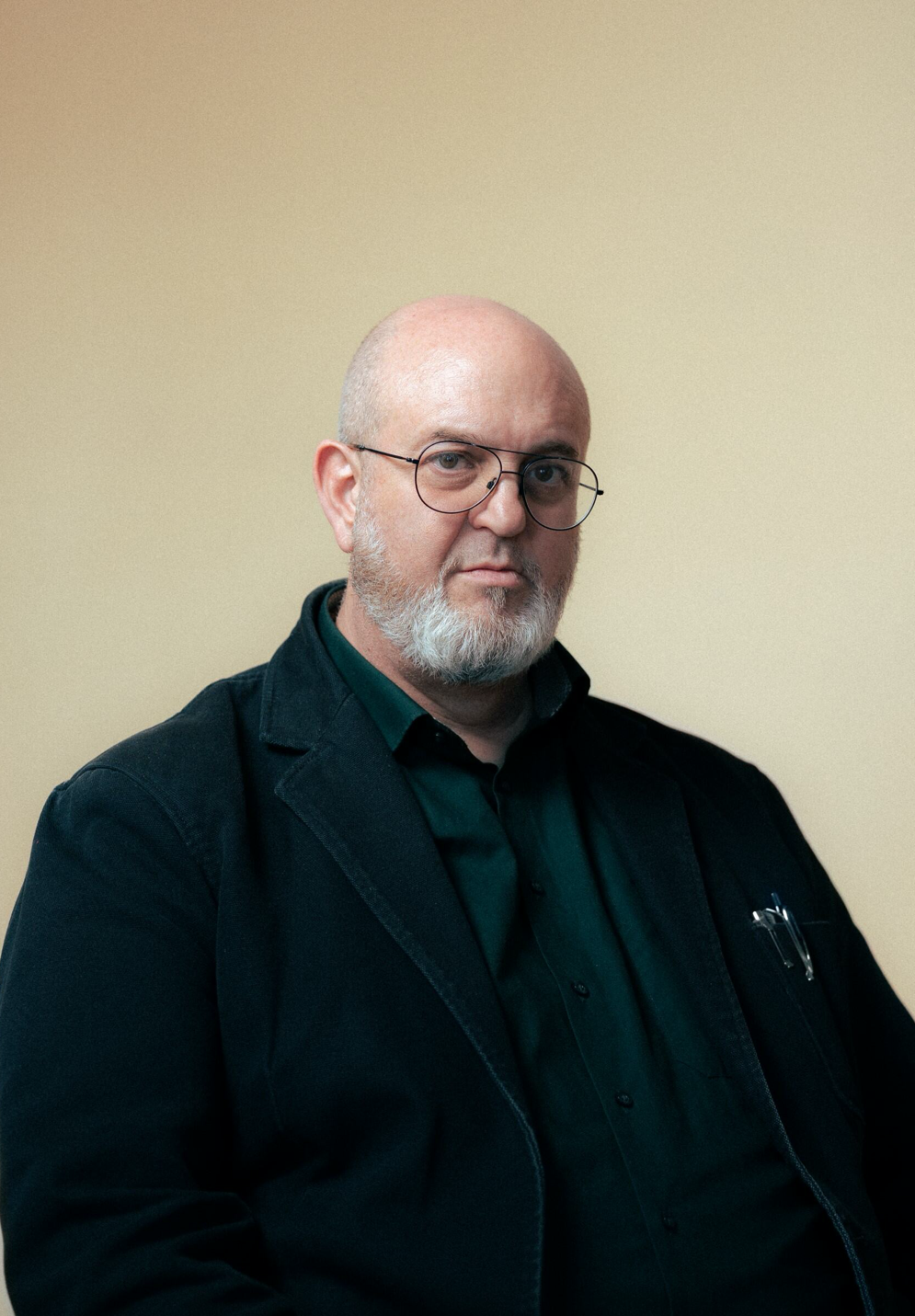
The theories of Karl Marx never left so securely between his ears; Cox is no longer willing to be kin to those called ‘Communists’, wishing to implement these ideas dogmatically upon the lived experience. The greys of the spectrum embraced for a flourishing intellectual life, distanced from those positions of power sure to corrupt, the privatization of ideology perhaps ironically bringing the man a most fulfilling march as a thinker.
In the end, Dr. Christopher Cox emerges not as a contradiction but as a testament to the complexity of the human intellect and experience. His life, rooted in counterculture, sharpened by political critique, softened by Buddhist reflection, and revitalized through music, illustrates how identities need not be confined to rigid categories. Instead, they can coexist, overlap, and evolve, naturally forming a spectrum that resists easy definition. For Cox, the balance between activism and detachment, theory and practice, passion and restraint is not a flaw but a philosophy in itself, an ongoing negotiation that mirrors the very contradictions of the world he seeks to understand.