by Daniel Arthur Egyed-Kiss
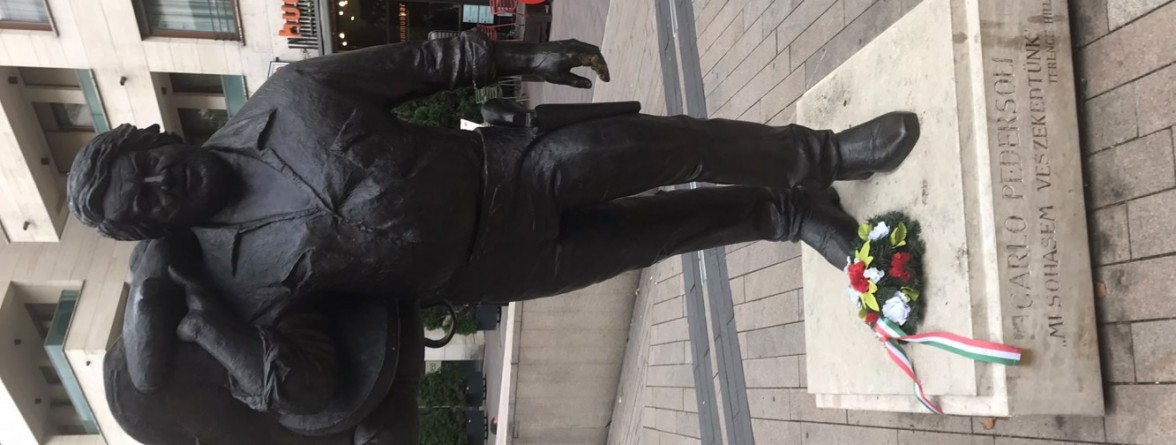
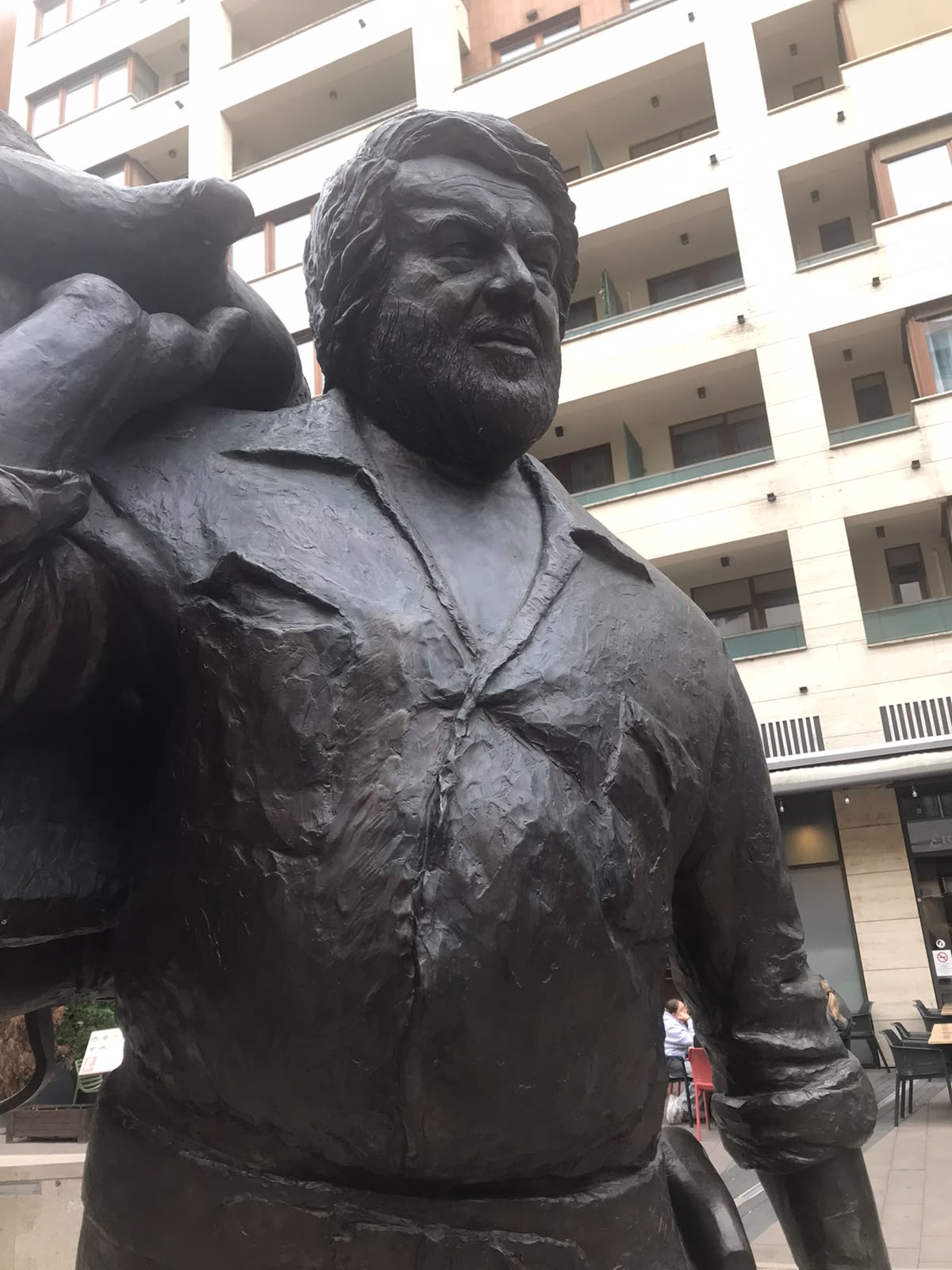
Take a stroll down Corvin Promenade in Budapest’s District VIII and you will meet a 2.4-meterbronze figure with a saddle slung over his shoulder. He is not a king, poet or revolutionary, he is not even Hungarian; he is Bud Spencer, an Italian actor who spent his career eating beans and punching villains on the head, nearly always alongside his quick-witted, blue-eyed partner Terence Hill – and Hungary was the first country in the world to put up a statue of him.
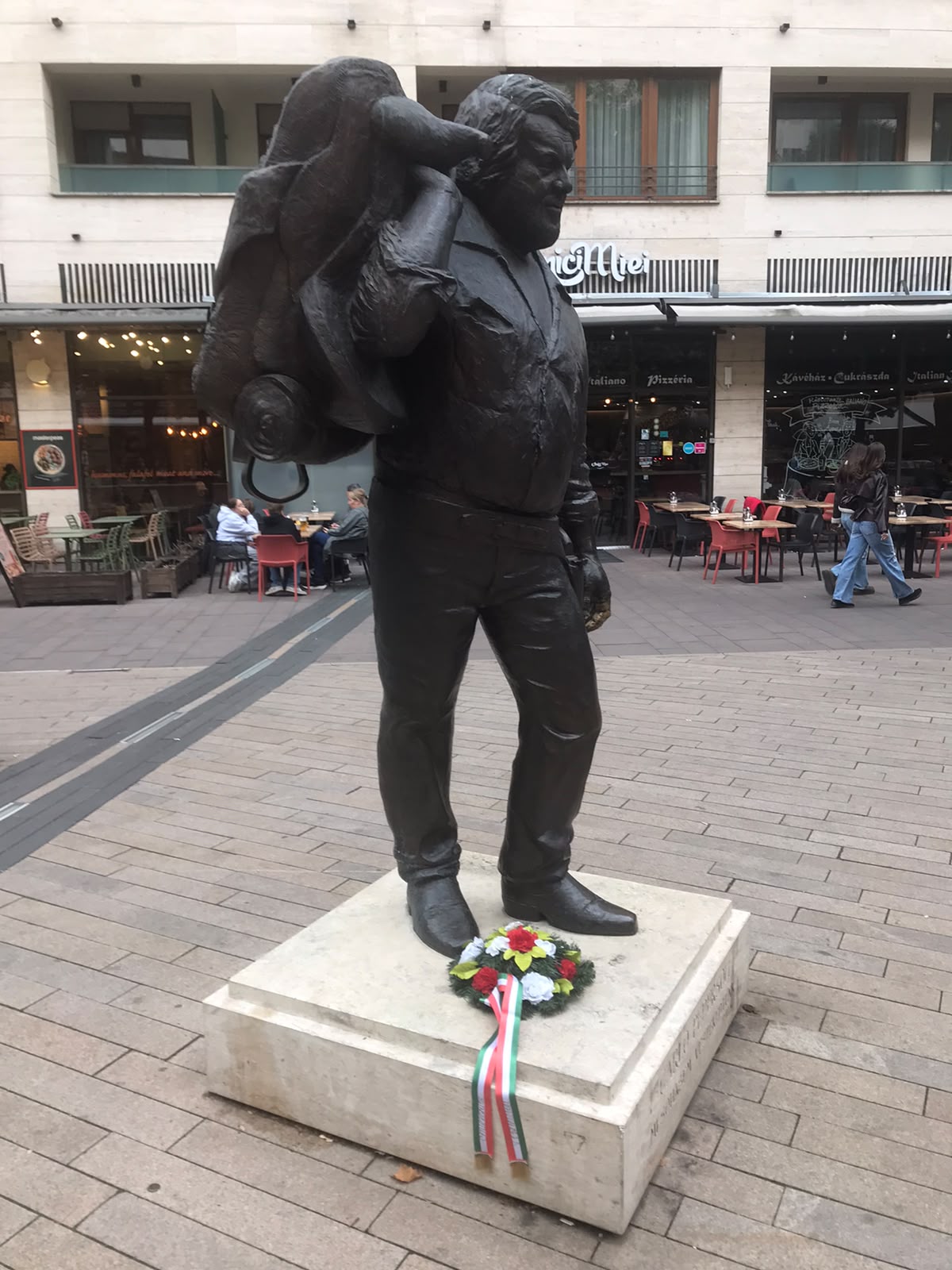
The statue’s unveiling took place in November 2017, a little over a year after Spencer died at 86. Its sculptor Szandra Tasnádi offered her work for free; the Józsefváros district council paid almost 9 million forints to cast and install it; and Spencer’s children came from Italy for the ceremony, where a local tribute band played the film themes. To understand why a working-class Budapest neighbourhood would honour a Neapolitan film brawler, you have to understand the double act that made him famous, and one of the strangest and most durable fan cultures in Europe.
The giant and the blue-eyed one
Bud Spencer was born Carlo Pedersoli in Naples on 31 October 1929, and was a national swimming champion and international water polo player who competed at two Olympic Games before ever stepping forth as an actor. His partner Terence Hill was born Mario Girotti in Venice in 1939, a lean former child actor with startling blue eyes. Both had chosen to adopt Americanised stage names, since Italian westerns had sold better abroad that way.
It was by accident that their partnership began in 1967, the original lead of the western God Forgives… I Don’t! had broken his foot, and was replaced by Hill opposite Spencer. Across the 27 years which followed they would end up making around 18 films together, ending with Troublemakers in 1994.
The breakthrough was They Call Me Trinity (1970), which turned the grim spaghetti western into slapstick, establishing a formula to barely change after: Hill is the quick witted, cheeky and laid back one; whilst Spencer is the large, moody giant fond of beans. Bad guys get slapped, no fatality really appears, and the fight ends in a pile of broken furniture. Subsequent films would move the duo to modern Miami, Rio and Africa, but the punches stayed the same.
Over in the anglosphere these films would end up mostly ignored, whilst here in Central Europe the audiences did the opposite. Nowhere did they embrace the pair more warmly than in Hungary.
Hungary: where the cult became official
Spencer and Hill arrived in Hungary through the side door of state socialism. Until the system collapsed in 1989, the government tightly controlled what Hungarian moviegoers could watch. Censors apparently judged these noisy, apolitical comedies harmless, so they allowed them in cinemas and later on state television.
What the censors overlooked was how much the films carried besides jokes. For a country whose citizens could rarely travel beyond the Iron Curtain, the films offered Miami beaches, Brazilian carnivals and Pacific islands, a world far removed from everyday life under communism. At the statue’s unveiling in 2017, a 43-year-old shopkeeper named Ignác Pál summed up this wider significance for the AFP news agency: “It was a piece of the West, of freedom, that we could reach.”
Nor did the films feel foreign for long. When the two Italians with anglicised names opened their mouths on Hungarian screens, they spoke fluent, funny Hungarian, in voices that would become almost as famous as their faces.
There is a sporting link too. Spencer’s water polo career connected him with Hungary, a nation that has enjoyed enormous success in the sport. That bond lasted a lifetime: Olympic water polo champion György Kárpáti, described as one of his best friends, attended the statue ceremony aged 83.
The affection ran both ways. In his eighties, Spencer welcomed a Hungarian beer brand’s team to his home in Rome and, as the trade journal Trade Magazin reported, told them, “My Hungarian fans and friends also contributed to my success greatly.” His official website was translated into Hungarian, and in 2016, according to the expat news site Xpatloop, he greeted his followers with a cheerful “Jó reggelt!” (“Good morning!”) after the Hungarian film Son of Saul won an Oscar.
Only a few months later, Hungarian fans were lighting candles outside the Italian embassy in Budapest. Spencer died in June 2016, and the tributes began almost at once. Within weeks, the satirical Two-Tailed Dog Party, a joke political movement with a serious following, “named” a patch of green near the Kaszásdűlő suburban rail stop after him and inaugurated it with a mock mass brawl in the style of the films. The district responded by asking local residents what they thought, and in September 2021 the Budapest city assembly made Bud Spencer Park official, as both Infostart and Hungary Today reported. A portrait mural appeared beside the suburban railway at Filatorigát in Óbuda, gazing down at commuters on their way into the city. The bronze statue on Corvin Promenade, unveiled the following year, is simply the most visible of these tributes.
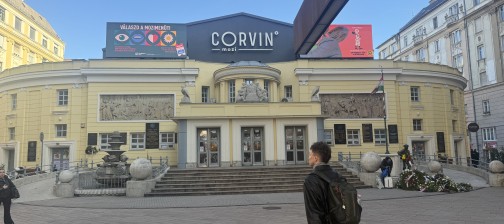
Away from parks and pedestals, the cult is at its loudest in music. The Spencer Hill Magic Band plays nothing but songs from the films’ soundtracks, to crowds who sing along to every word. In November 2016 the brothers who wrote many of those songs, Guido and Maurizio De Angelis, filled Budapest’s Sportaréna, a venue usually reserved for international pop and rock stars. Fans also gather in person: a festival that started with 40 or 50 people grew to nearly 1,000 by its ninth edition at Zánka on Lake Balaton, and the Corvin Cinema, remembered as a stronghold of the 1956 revolution, has hosted screenings of the duo’s films. At fan events there are often steaming pots of onion-and-bean stew in Spencer’s honour, and his autobiographies, naturally, are available in Hungarian.
The power of the dub
To English-speaking audiences, dubbing is often a punchline: mismatched lips and wooden delivery that sour the experience of a foreign film. In countries such as Hungary and Germany, however, it is closer to an art form, and the Spencer–Hill films may be its greatest success story. Both countries dub nearly everything, few moviegoers watching with subtitles, so for most viewers the voice coming out of Bud Spencer was never his own. It belonged to a local actor, speaking lines written by a local translator, and over the years those voices fused with the faces.
Hungary shows just how complete that fusion could be. Spencer’s best-known voice was that of István Bujtor, an actor who even shared his bear-like build; the match having worked so well that Bujtor later borrowed the persona for the hero of his own popular Hungarian crime comedies. Lajos Kránitz was Spencer’s other regular voice, while Gyula Szersén and László Újréti gave Hill his cheek. The lines they delivered became a shared vocabulary. Many Hungarians can quote entire exchanges from Kincs, ami nincs (Who Finds a Friend Finds a Treasure, 1981), often named in fan polls as the duo’s most-loved film in the country, and the dubbing actors remain guests of honour at fan events to this day.
If Hungary shows how a voice can become part of a character, Germany shows how much a translator can add to one. Berlin writer Rainer Brandt did not so much translate the Italian scripts as rewrite them, filling every scene with unique wisecracks the originals never had. He called his style Schnodderdeutsch, roughly “lippy German”, and it packed West German cinemas throughout the 1970s and 1980s. When Brandt died in August 2024, the German broadcaster ZDF reported that Terence Hill, whose mother was German, had told the newspaper Bild that Brandt and the German voice actors played “a huge part” in making the films even more successful there. The affection they built still runs deep: in 2011, more than 100,000 people voted online to name a road tunnel in the town of Schwäbisch Gmünd after Bud Spencer. The council said no, though it renamed the local pool in his honour instead.
Different as their methods were, the two countries arrived at the same place: a sense that these films belong to them. A Hungarian and a German who grew up on the same movie will remember entirely different jokes, and neither will be quoting the Italian original. In a very real way, the Bud Spencer that Hungarians love was made partly in Budapest.
Why it stuck
No single cause can explain the cult, but a few ingredients keep coming up. The first is that the violence never hurts. Hundreds of punches land in these films, yet characters seldom bleed or die. In an interview marking his 80th birthday in 2009, Spencer insisted that the films had nothing to do with violence, arguing that his trademark hammer-fist to the head was so comic that even small children laughed at its absurdity. That made the films safe for censors and families alike, allowing children to watch and enjoy them on the sofa between their parents and grandparents with ease.
Time did the rest. After 1989, endless television reruns handed the films to a new generation, and nostalgia turned childhood viewing into a shared memory. But perhaps the simplest explanation is the best: the duo’s heroes are laid-back, hungry, honest and loyal to each other, and that never changes. They reliably defend the weak without lecturing anyone, then go home for lunch. Such a formula provides an easy, inoffensive fantasy to love in any decade.
That very ease is what makes some Hungarians uneasy. Reviewing a Hungarian documentary about Spencer for the news site 444 in 2019, film critic Márk Herczeg, himself a childhood fan, joked that in Hungary “it is almost less acceptable to speak ill of Bud Spencer than of Jesus”, and argued that it was time to let the legend rest. Even his complaint, though, ended with a promise to keep watching the films on weekend afternoons.
Still swinging
Herczeg is far from the only one still watching, and the cult is not just a memory held by people who grew up before 1989. In October 2016, an Italian studio called Trinity Team crowdfunded a retro video game, Slaps and Beans, raising more than €200,000 from about 6,100 backers. It came out in 2017 with the families’ approval, and a sequel followed in 2023. A generation that never had the chance to see the films in a cinema now punches its way through them on a games console.
The surviving half of the double act has seen that devotion up close. When Terence Hill came to Budapest in September 2018 to premiere his film My Name Is Thomas at the Corvin Cinema, the same cinema that has hosted festivals of the duo’s films, 444 reported that large crowds of fans turned out to greet him, decades after his heyday.
Eight years on, Hill has not quite stopped either. He turned 87 in March 2026 and retired in 2022 from his long-running Italian TV role as a crime-solving priest in Don Matteo, but his German manager said in a podcast that Hill planned to shoot one more western in early 2026. Whether that film appears or not, his fans in Budapest, Berlin and beyond will keep the duo on screen through reruns, festivals and the tribute band’s concerts.
A saddle on his shoulder
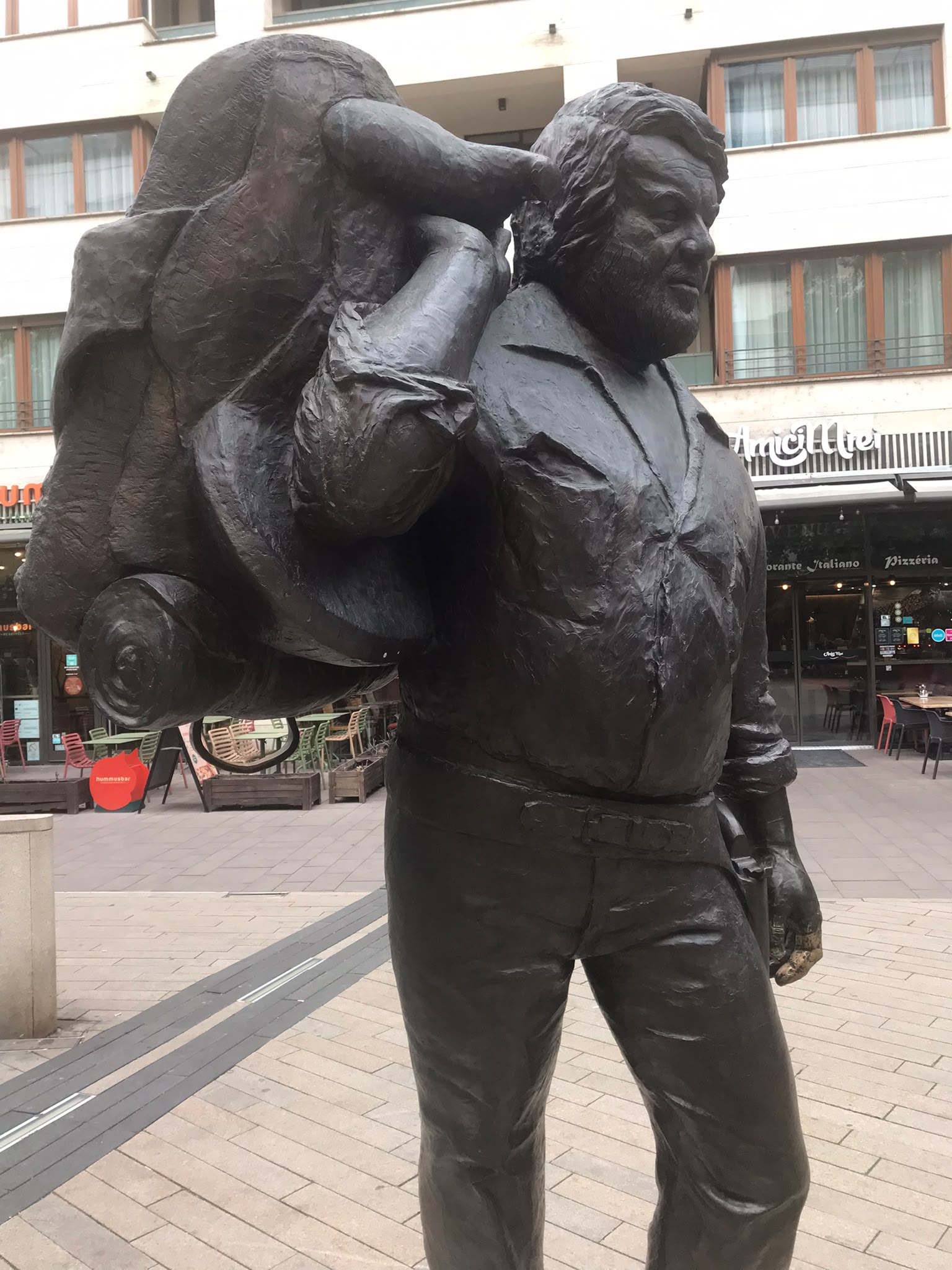
The Budapest statue’s design, and the quote on its plinth comes from Spencer’s funeral. Hill having told his fellow mourners that he was sure his friend would be waiting for him in heaven with a saddle on his shoulder, just as in the opening of Trinity Is Still My Name, and would say the words he would repeat at every dinner they shared: “you and I never had a fight” (written “Mi Sohasem Veszekedtünk” on the plinth in Hungarian). That a Hungarian sculptor chose this image, and a Hungarian district paid to cast it, says a lot. For millions of people who grew up behind the Iron Curtain, the big man and his blue-eyed partner were never just two Italian actors. They were proof that somewhere out there good guys won, bad guys got a slap, and there was always a treat of beans waiting at the end.
Photos by Daniel Arthur Egyed-Kiss